Saturday, December 3, 2022

The 49th State is Alaska and the name of an Anchorage brewery

         This fall I got to thinking how long ago it had been since I had seen Alaska (close to half a century) and when I learned of the Great Alaskan Beer Train run on the Alaska Railroad, I figured I should go up there again.  A flight to Anchorage  and soon I was at the tourist information center, a log cabin in the heart of downtown.  Lining up some sightseeing trips led to the identification of some vital destinations in center city.  


Two blocks from the tourist center I spied the brewpub 49th State Brewing and moseyed in for a mid-afternoon pint.  The substantial building sits on the edge of a bluff, created by the 1964 earthquake which rocked the city, traces of its damage still plain to see.  A 15-bbl brewing system in the lower level cranks out a good choice in beers.


The tap handles at the bar indicate the variety of styles.  Some are carved from local materials like whale bones.  I tried a pint of the Blonde Eagle (5.2%) upon learning that this was the flagship ale.  Stomach full, I passed on the foods offered in the menu but saw a number of tasty-sounding salmon options.  


The Russian Imperial Stout (11.2%) merited a can to take to my lodgings and try that evening.  William Seward, the Secretary of State named to his cabinet by Abraham Lincoln and still serving Andrew Johnson in 1867, negotiated the purchase of Alaska from the Russians for $7.2 million.  The transaction was derided by some in Congress as Seward's Folly; the critics had no idea of the riches this land contained.  The rich, sweet, malty flavor disguises the potent alcohol content of this one-and-done stout.  


(Visited 09/29/2022)

Friday, December 2, 2022

Found in Schenectady: Frog Alley


        The old factory town of Schenectady (light bulbs and GE appliances, locomotives), for several postwar years home and source for fiction ideas of Kurt Vonnegut, has been perking up a bit from its classic rustbelt look lately.  Near the Mohawk River and the community college, lower State Street now features a block of new buildings, capped on one corner by the Frog Alley Brewing Co. Open since 2018,


the brewery shares a wall with Annabel's Pizza, where pizza and sandwiches can be ordered through an opening in the pub. An expansive area in the back offers frequent music events.  The name derives from a once-marshy area near the river and then an eponymous baseball team. This sporting nine became famous in 1903 by playing a game vs. Albany on a Sunday, in violation of the blue laws, and spending the night in jail courtesy of the Schenectady P.D.  

    Brewing is done on what looks like a 20-bbl system with a canning line.  Draft beer flows though a pair of sixteen tap handles. While IPAs predominate, good choices remain in the darker and maltier styles. I tried a flight with a winter ale (pale in color but with the same spicy flavors that marzen style usually has), a pilsner, a brown and a porter.  All nicely done and the darks would have been good for a pint later.


    The day I stopped in, the World Cup was on and the U.S. vs England game was starting to draw a crowd near one of the many tv screens in the pub area.  


(Visited 11/25/2022)

Wednesday, October 19, 2022

District Brewing, Mt. Vernon, two+ years old

Around the time the Covid pandemic began, spring of 2020, I went into blog hibernation on this site.  This was due to some google changes I didn't process, had nothing to do with masking up or getting tested or all those pandemic things.  New breweries that had been in the planning stages in 2019 managed to open in 2020 in spite of the challenges of that time.  One such was District Brewing, right here about five blocks from my apartment.  They opened in the late spring with pizza to go or eat outside and a choice of beers in 12-oz cans available from the get-go.  The site used to be the Lyric Theatre, a cinema back in the day, and they name their pizzas for classic old movies.  The beer names not so much, with one noble exception.  Sean Connery passed away in 2020 and District, then bringing out a rich, malty Scotch ale, named it Connery Scotch, a tribute to the Scottish actor.  

As pandemic restrictions eased up last year, indoor dining came back to District.  Two views from 


the balcony level, one out toward the Skagit River, with the Mount Vernon Farmers Market in the foreground, the other looking at the 15-barrel brewing system through the huge glass window wall. My next stop will be for a Red October pizza (Go, Phillies!) and a pint of Connery Scotch.  

(Visited many times since 06/20, most recently 10/17/22)
 

Wednesday, October 12, 2022

Glacier Brewhouse and the Great Alaska Beer Train

The Alaska Railroad, established and for many years operated by the federal government, was purchased by the state in 1985.  Headquartered in Anchorage, trains run north to Fairbanks and south to Seward and Whittier, where the big cruise ships dock.  In addition to scheduled runs, the railroad sets up special excursion trains with various tourism-focused companies.  

One such company, Glacier Brewhouse in downtown Anchorage, celebrates October with the Great Alaska Beer Train, a four-hour run along the Cook Inlet with fabulous views, delicious food, and of course plenty of beer. A $200 ticket buys you the experience, six half pints of different beers paired with the food, and the food, of course, brought to you at your seat.  Here is the menu for 2022: 
And this was how the bratwurst sausage was served--

The train doesn't cover a lot of distance in the two hours south, maybe fifty miles.  It does a turnaround and heads back to Anchorage at the same speed, with plenty of time to sip and savor the scenery and the beers.  The sixth token for a half point can be your choice after trying the five on the list.  I went back and had another strong stout!  Wish I had had a Seward's Folly to compare it to.  
I checked out Glacier's restaurant/taproom the next day.  They make at least a dozen beers so there were some good brews that didn't get to ride the train this year.


(Train ride 10/01/22)

Saturday, August 29, 2020

Triple Bottom: Spring Garden gets craftier

Triple Bottom Brewing Co., seen here from the steps of the Roy-Pitz Barrel House on busy Spring Garden Ave., became the third brewer in two blocks (Love City being the other) when it opened in October.


Sunday, December 29, 2019

The Ways to Glenside, PA

Upon first hearing of The Ways Restaurant and Brewing Co., I had to wonder what sort of ways they were talking about.  "Let me count the ways" [how I love you], in Elizabeth Browning's poem?  Or "knowing how way leads on to way" in Robert Frost's Road Not Taken?
None of the above!  Way is the surname of two brothers, Tim and Steve, natives of the town next door, Jenkintown, who opened this cozy pub about six months ago.  Steve Way operated a popular food truck, Smokin' Tacos, for some years and played at home brewing on the side.  Tim Way spent some years as a nurse in an ER and then opted for pro-level brewing with studies at the American Brewers Guild school in  Vermont and a turn at Weyerbacher in Easton, PA. 
 
Tim makes beer on a ten-barrel system with a novel array of finishing tanks: four fermenters and six brite tanks.  The brite tanks link directly to six of the dozen taps behind the bar.  The other six dispense from kegs, three of their own and three guest taps. I tried two different stouts to go with a bowl of Guiness beef stew, just right on a chill December afternoon.  The first was Attache Case, an English style stout, sweeter than Irish versions, dry-hopped with Fuggles and EKG hops (5 % abv). Next was a pint of August West, an Oatmeal stout with local coffee and chocolate added (6.6%) type which came next.  Both delicious in their different "ways".

The pub was doing a good business
in gift cards and growler fills this last Saturday before Christmas.  The other beer choices in the local offerings were four IPAs, a Helles, an Alt, and a fruit lager with blueberries and tart red cherries in the mix. Rapidly becoming a neighborhood fixture.
The Ways' logo features the intersection of a highway and a railroad's tracks, which describes the pub's location perfectly.  It sits smack beside the SEPTA lines to Doylestown and Warminster and is a stone's throw from the station. 

(Visited 12/21/19)

Saturday, December 14, 2019

Inland Empire Festival in Spokane

A good time on Friday, Sept. 20 on the outfield grass of Avista Stadium, home of the Spokane Indians baseball team.  Coming in, I noticed a plaque telling the world that this is one team that can call itself the Indians without controversy.
Some thirty-plus brewers had set up on the outfield grass: a few, like No-Li here in Spokane and Bale Breaker in Yakima get over the mountains to Western Wash, while most do not.  The barley growers have an association and had set up a stand reminding us that all our favorite styles begin with their crops.  And the hop union was there, as well.
In downtown Spokane a craft beer incubator has opened up, a building where entrepreneurs can move out of their garages and start brewing commercially.  I met one, TT's Brewing, that had just graduated from the incubator and opened up their own brew space recently. 
(Visited 09/20/19)

Monday, June 24, 2019

Ambler's Tannery Run: home of the Splatch

Ambler, PA: a delightful Philly suburb with memorable one-off beers at Forest and Main and a flat-out elegant old movie house showing art house flicks.  Coming out of an exhilarating two hours with Elton John's biopic Rocketman, I spied a new brewery right across the street: Tannery Run Brewing.
Open to the street in the good weather, the brewpub sits in a re-purposed old brick building, yes, once a tannery, and built over a small creek, which are called runs in this area.
The brewery's taproom opened last St. Patrick's Day, about fifteen weeks ago.
The tap list offered a good selection of popular craft ale styles, some IPAs, saisons, wheats, stouts, etc.  To most of them the word "splatch" had been appended, so my first question to one of the brewers was "What's a splatch?"
It means "split batch," Tim said.  "Which means we cook up a batch of wort in a big mash tun and then we split that batch between two brew kettles sitting side by side and add different hops and yeast to each kettle as the recipe calls for."   Thus, out of the same grain bill they get Ambler Oracle (a pale ale, 4.9%) and a Jasmine Man (Belgian strong dark ale, 7.2%).  Some of the splits are logical, a milk stout and an Irish dry stout.
In the picture, the mash tun is in the center, brew kettle #1 is to the right, and brew kettle #2 sits atop the hot liquor tank behind the mash tun.  I tried the milk stout, a good creamy example of the style.
Time will tell whether splatching leads to unusual tastes or is more of a brewer's budget technique.  Tannery Run has a good vibe and a busy social presence.
(Visited 06/13/19)

Thursday, May 23, 2019

The devil is up the creek in South Jersey

       I rolled into Devil's Creek Brewing Co. in Collingswood, New Jersey a day after their third birthday party (the same day my granddaughter Ella was turning five!).  No beer for Ella but plenty was flowing at the brewery's taproom.
      Collingswood is a dry town; the fancy restaurants on the main drag are all BYOB.  The only exception to the local prohibition law in the Garden State is an establishment for the manufacture of an alcoholic beverage.  The brewery is allowed to sell what they make here, by the glass, the growler, or cans to go.  No  guest taps, no wines or ciders, no food made on the premises, no TV screens, or anything else that seems pub-like.  But when they opened three years ago, Craig the bartender said
the lines went two blocks back. The novelty of getting a foamy mug without BYOB is still going strong.
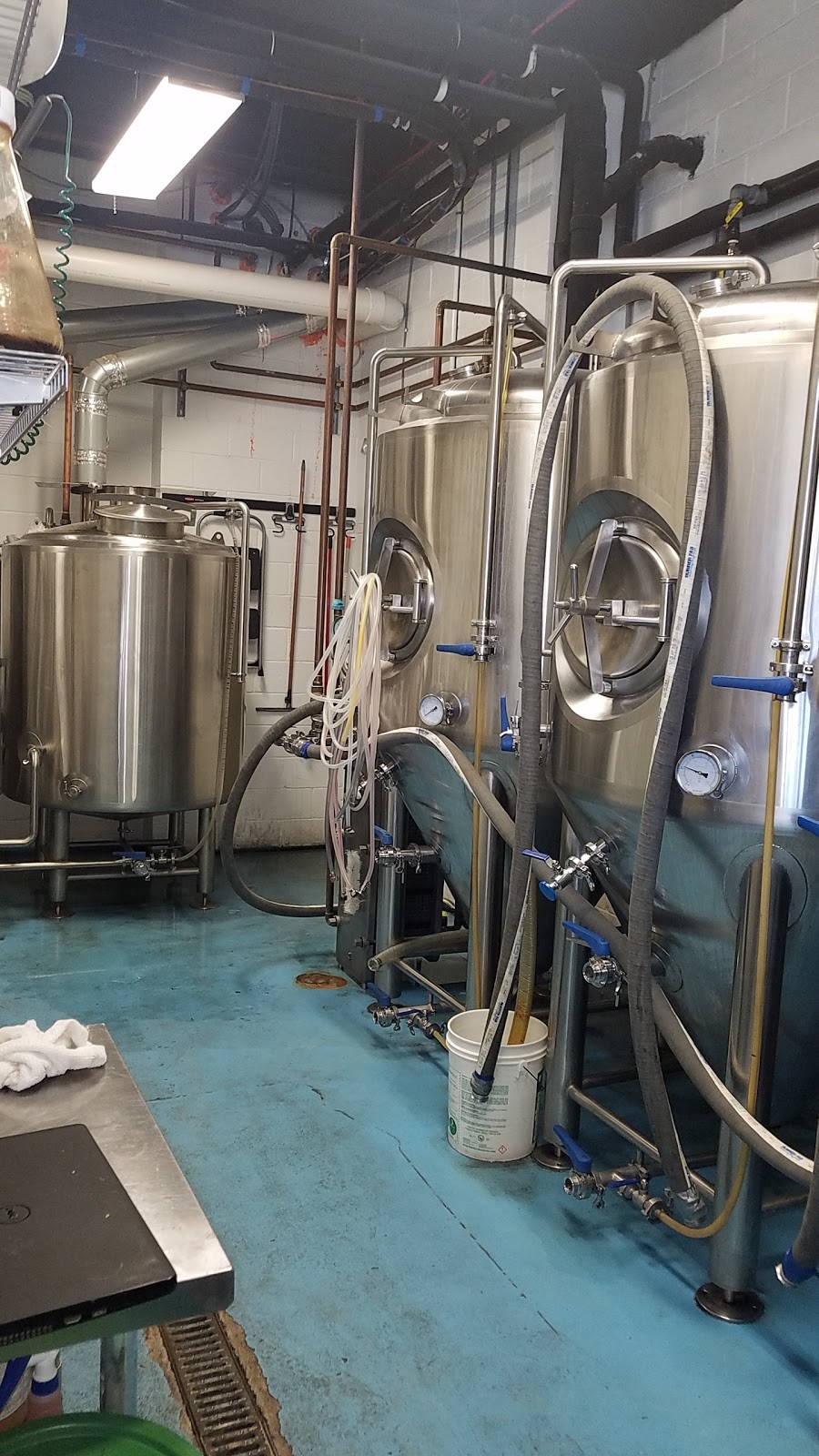
   The 7-bbl fermenters need a double batch from the 5-bbl brew kettle in order to fill.  The production space and the taproom out front have the corner suite of a new building called The Lumberyard (what the space was for eighty-odd years, until Lowe's and Home Depot did it in).  The owners, Kathy Ganser and Anthony Abate, are actively involved in the business--she brewed one of the IPAs and applied her graphic arts background to designing the distinctive artwork here.
     Well.  My first four-oz flight had to be Birthday Cake (4.3%, 12 ibu), a cream ale putting out intense notes of raisins and cinnamon.  They made this for the second birthday in 2018 and had to bring it back.  A cleansing sip of water before the second taste, a delicate Pear Gose (5.1 %, 6 ibu).  Round three of the four flights was Caramel Apple Brown (5.4 %, 20 ibu), a malt-forward ale that delivered apples to the nose and caramel to the tongue--a medal-winner at a recent festival in Atlantic City.  The last was McBeer, an Irish take on the brown ale style (4.5%, 22 ibu) with honey for alcohol and sweetness.


The devil supposedly seen in the area in the 19th century looked a bit like a dragon, a chicken, and a kangaroo, according to art director Kathy.  I was delighted to find, among the glassware for sale, a pint in this curvy shape.  Most breweries sell tumblers, tulips, maybe pilsner glasses but this shape is a personal favorite.
Cheers to New Jersey!

(Visited 05/19/19)

Wednesday, May 15, 2019

Garden Path: stretching the concept of what a brewery is


The sign outside the building proclaimed it a brewery.  The familiar aroma of malt mashing away in a tun was lacking, but that depends on when a small brewery gets cooking.  I entered the taproom of Garden Path Fermentation,  near the Skagit County Airport in Burlington, Wash., looking at a bar with eight or nine tap handles ready to pour. Then I peeked through the glass into the production area in the back and saw nothing but barrels, hundred of wooden barrels. Where was the mash tun, the brew kettle, the cone-bottomed fermenters?
Amber Watt, one of the brewer-owners, took a small tour group into the back and explained the
unique process here.  She and her partner, Ron Extract (real name!) contract with Chuckanut Brewing, just a quarter-mile down the road, to produce the wort for Garden Path.  They truck the wort here, cool it down,  and usually put it in one of the half-dozen foeders seen here.  They pitch their unique yeast here (more about that in a moment) and get the souring fermentation underway here before transferring the beer to wine barrels.
The yeast they culture from local flora in the verdant Skagit Valley; several dozen carboys in a corner of the space are devoted to this process.  They normally pump the yeast into their yeast brink, clean out the foudre, and repitch to the next batch from the brink.  No two batches are alike here, and when they bottle, each batch is numbered on the label. 
Amber and Ron picked up a tank from a dairy in Wisconsin and have repurposed it as a coolship for some of their beers.  Here, they fill half the tank with hot wort from Chuckanut, and let the temperature attenuate overnight while the rest of the batch is cooled in the heat exchanger and taken to a foudre for yeast pitching.  The coolship half of the batch is hopped with whole flower hops and then added to the foudre half and let them ferment together.  "Our house culture is pretty hearty," Amber says, "so it takes over really quickly."  This process results in two beers, The Wet Hopped Ship and The Old School the New. 
All beers are bottled with a dollop of honey from an apiary a few miles up the Skagit.  "We want to use local ingredients whenever possible," Amber said, "and brewer's priming sugar was nowhere near as local as this honey."  I had a pint of the Wet Hopped Ship last St. Patrick's Day and small samples of a couple others, enough to aver that if your sour taste buds are on, you will encounter delicious flavors here.

(Visited 03/17/19)

Monday, March 25, 2019

Victoria Beer Week, take 2

Five years ago I went to Victoria, B.C., the capital of the province and a touristy cruise-ship stop, for their second-ever beer week.  This month I got back to the event and found all breweries I had stopped off at in 2014, all seemingly thriving. I stayed in Swan's Hotel and Brewery for a night; Swan's had a deal on some small second-floor rooms right over the pub, discounted for the noise factor, and I took one.  But the pub was being remodeled, was closed, and I missed the decibel experience.
Canoe Brewing, a block from Swan's, seemed unchanged, still with the great waterfront view and the stylish interior.   But the next stop on my Saturday afternoon stroll was to Phillips Brewing Co., and
In 2014 Phillips was a straight production brewery in the B.C. mode, growler fills just a few hours a week and bottle sales just in bombers. Today, a jazzy new sign heralds a lively brewpub, a dozen house-brewed styles on tap, hockey on the tube, and growlers filling up every day.  My server told me this had happened in 2016 with more changes like a line of soft drinks and canning for the beers and the pop.
Phillips has definitely seen big changes.
Beer week in Victoria is a series of events curated/produced/imagined by festival staff, led by beer writer Joe Wiebe.  The Saturday night program was called All About the Wood, a celebration of barrel aging.  A dozen breweries from across B.C. brought beers they had aged in a variety of barrels--bourbon, wines of all sorts, gin, rum, tequila.  Some poured from kegs, some from bottles.
Brewers or knowledgeable people from the brewery fielded questions about this process.  Bourbon barrels, by law, can only be used for bourbon once so they are available to brewers after that, with plenty of oak still on hand to mingle with the whiskey flavors. Wineries and distillers of other liquors get more use out of a barrel before they sell it.  Dageraad Brewing in Burnaby brought their Cuba Libre, a Belgian dark ale aged in rum barrels.  Well-used rum barrels, the brewer said, some used so many times they were falling apart and leaked too much beer to be usable.
An unusual taste was Quintus, a dark saison brewed with figs and sumac berries and aged in whiskey barrels.  Torchlight Brewing came over the mountains from Nelson, over on the eastern side of B.C/

Sunday morning I walked up Government St. past Phillips and then past Vancouver Island Brewing, founded in 1984 and still going strong.  The city had posted a rezoning notice to the effect that VIB was applying for a pub license for on-premise sales, just as Phillips had done.  A left at the next corner took me past Hoyne and Driftwood, side-by-side production breweries as they had been five years ago.  A couple more blocks and I was at Moon Under Water, another pleasant experience from 2014.  Maybe three dozen people had gathered, all home brewers here to learn from Clay and his brewing staff by following the early steps of making an ale on the small pilot brewing system.  The ticket here included a sandwich and a pint of your choice--I chose Creepy Uncle Dunkel, which was the same beer I had here five years ago.
The picture on the right shows the homebrewers jotting notes on the brew day worksheet the Moon folks provided.  The three tanks over the stored kegs caught my eye.  I wondered if they were horizontal fermenters.  No, Clay said, they were a new Dutch-made system for delivering beer to the taps in the pub out front.  Saves time switching out kegs and delivers more consistent beer to the front of the house. 

So all the breweries I had seen in 2014 were still going strong in Victoria, in several cases growing and adding new features.  A great beer town.
(Visited 03/02-3/19)


Thursday, March 7, 2019

Snohomish: a new ale trail and PBJ in acan

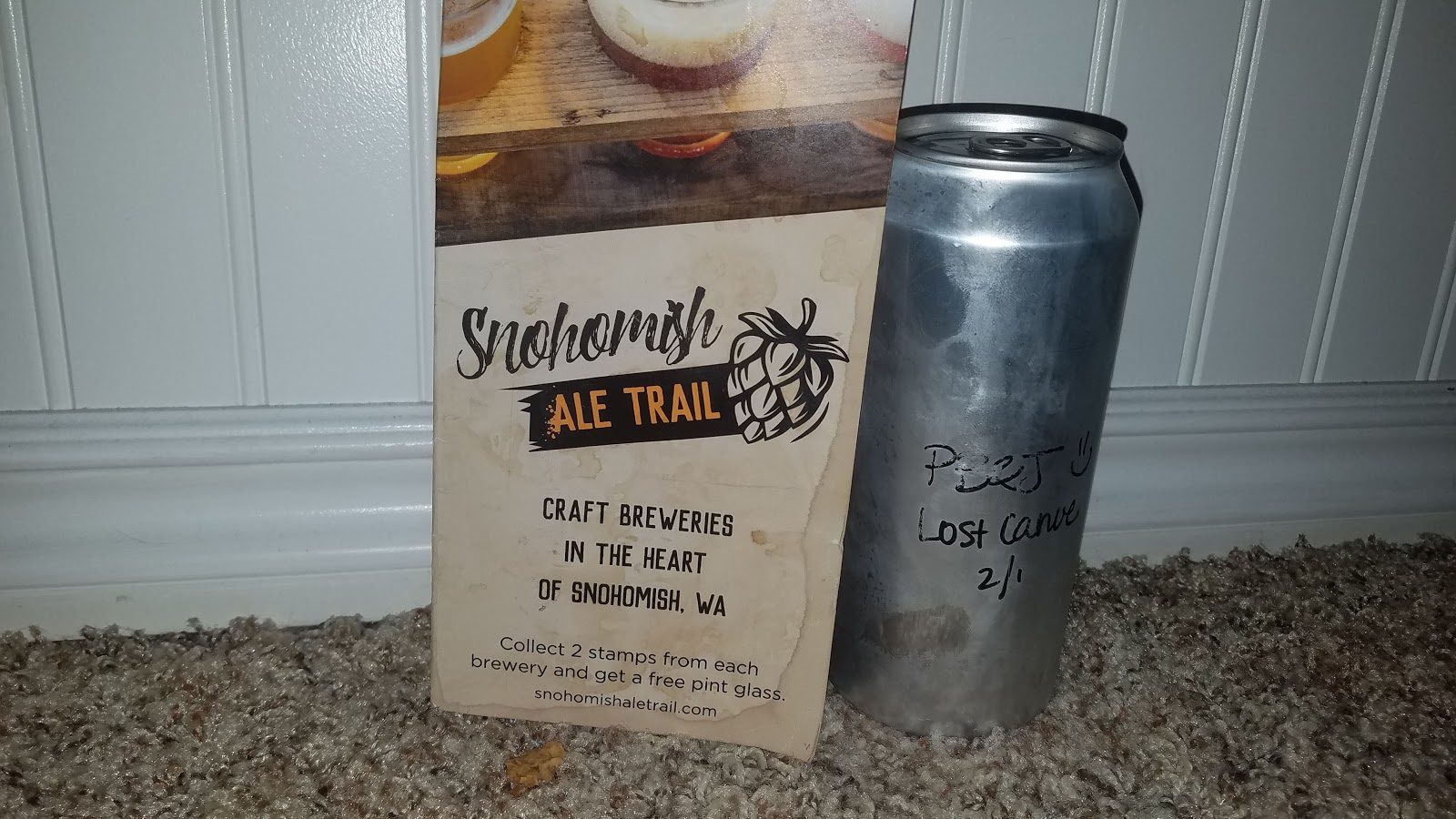
The attractive town of Snohomish, Wash., about a dozen miles east of Everett, has gone from no breweries to six in just that many years.  I've visited each of them and posted my notes here.  When I read a story in Northwest Brewing News about ale trail programs in other areas in the region, such as those in Bend, Bellingham, the South Puget Sound, and the Inland Empire, I was keen to check out the new Snohomish Ale Trail.
I started at Sound to Summit Brewing, still operating in the same business park off Bickford Ave.  The doctor and dentist couple who launched this brewery have sold it to the folks who own Lost Canoe Brewing, the next nearest and next oldest brewery in the town.
I took an ale trail program to Lost Canoe after collecting one stamp at S2S.  I was happy to see Lost Canoe was fermenting in sturdy metal tanks now (the last time they were using plastic tanks they had to hang in chains from the ceiling).  Here I had a pint of peanut butter porter, and then noticed a new mini-crowler machine that could fill 16-oz cans.  How cool is that!  A pint for here, a pint to take home.  The bartender said she could pour a blend right in the can, half peanut butter porter and half raspberry wheat ale.  Two stamps and a conversation can to take home.

I checked into a B&B a couple miles out of the town and took a nap, time to metabolize the intake. Later, restored, I checked in at the Spada Family Brewery's taproom, in the downtown area, for one of their signature sours, and then out to Haywire Brewing, still in the old dairy farm barn. Supper was a burrito from Ixtapa and a pint of Loose Rooster at Sno-town Brewing, all at the same corner on 2nd St. Hot IPA made with the peppers Frank's mother grows down in Arizona.
The sixth brewery here, Scuffypunk, was not open in my time frame so will have to bring my dance card back there another time. 
(Visited 02/10/19)


Friday, November 30, 2018

A stitch in time tastes fine in Wilmington

Wilmington, Delaware, the largest city in the First State (first to ratify the Constitution back in 1787) presents a pleasant downtown, even if retail has been gutted by malls which sell without sales tax to the nearby Jersey and Pennsylvania folk.  Seven or eight blocks from the train station, up Market Street, one can stop at the pub of Stitch House Brewing Co. for a pint.
The Stitch House name is based on a former retail tenant, the Linen Mart; its original use was as an ice-making plant. The brewery opened March 18 this year and was doing a good trade after eight months, on a sunny Sunday afternoon.  Twelve beers were on tap, eleven their own and one a collaboration.  This lineup included three IPAs and two pale ales, and in more adventurous territory, a rauchbier, a kolsch, a shandy, and a pilsner.  I had to sample the Baby Guava Dava, a sour Berliner Weisse made with guava in the boil and kettle-soured, I assumed. A tasty example of the style. 
With a mac and cheese plate I paired one of the pales, Big Stitch Nick, a clean-finishing ale with little aroma (5.6% abv).  The collaboration is called Out and About Oyster Stout, brewed for a recent festival event.  Andrew Rutherford, head brewer at Stitch House, worked with his counterparts at Iron Hill, Two Stones Pub, and Wilmington Brew Works to concoct this delicious black stout with the oyster juices trumping the usual coffee and chocolate notes in a sweet stout. 5.2%.


Stitch House utilizes five seven-barrel fermenters and a brew kettle in the street side window.  Waitstaff said most of the production is consumed here on the premises, with one or two other downtown spots having their kegs on tap. A slow and steady launch seems like a prudent beginning.


(Visited 11/11/18)

Thursday, November 29, 2018

Phoenixville Pt. II-crawling toward the castle

A pub crawl along Bridge St. in Phoenixville continues for three or four blocks past the Main St. corner where Root Down brews.  After Root Down, the next two are branch pubs.  The Iron Hill chain began in Newark, Delaware in 1996 and now has upwards of twenty locations in Delaware, south New Jersey, and the greater Philadelphia area. The business model is like McMenamins in the Northwest, with small breweries at each site supporting mostly on-premise consumption in their full-menu restaurants.  Some styles are made in all locations, others can be unique to that pub. By the way, Iron Hill says they won two GABF medals in their first year of competing, in 1997.

Further up Bridge St. one encounters the Rec Room, the  newest outlet of Conshohocken Brewing Co., opened last December.  The original plant and main production brewery opened around 2012 some fifteen miles down the same Schuylkill River in the town of Conshohocken. Its best known beer and recent medal winner at the World Beer Cup is an ESB, Puddlers Row. Know it well, and it is a good example of a style not all breweries make.

Several doors up from Conshy's Rec Room is Crowded Castle Brewing, located in another building
with a modernized facade in front of another repurposed business space.  This was once a printing press operation, vacant for some years.  These guys had eleven taps working, four of which were IPAs, and some unusual stuff in the other seven.  I tried some Centurial Sentinel, billed as an agave ale aged in tequila barrels, 5.4% and endowed with a desert aroma.  I gave the Defiance Alt a shot--they describe this as top fermented with a kolsch ale yeast and then aged cold like a lager.  Comes out medium dark with a nice head, good mouthfeel.  4.8% abv.
The logo, shown on the right, is a nice bit of work and will look good on a label when they get around to bottling. 
My last taste here was a short glass of Kahuna Umi Umi, a lager which earns the Hawaiian name by being aged on ripe pineapples.  That fruit does linger in the finish. 
A pleasant, cozy space with a good vibe.

(Visited 11/17/18)

Putting roots down in Phoenixville

   Phoenixville, Pennsylvania sits along the Schuylkill River near Valley Forge, maybe twenty-five miles outside Philadelphia.  The factories that got the town going are long gone now, but the 15,000-plus people who live there have found other kinds of work.  Including, of late, brewing.
My first couple of times in Phoenixville including stops at the brewpub of Sly Fox Brewing, a well-run operation executing a solid business plan including canning from the get-go and competitively priced growler fills (reminds me very much of Kulshan in Bellingham).  I didn't realize their downtown section was a lively spot for beer tourism until lately.
   Last Nov. 17 downtown Phoenixville put on a pub crawl: six stops at the four breweries, the distillery, and the wine shop, earned one some swag.  Said crawl was all along a three-block section of Bridge St., the main drag as those of us of a certain age used to say.  I misspeak: the first stop going east to west is Root Down Brewing, at 1 Main St., just off Bridge. This brewery, opened just

in 2017, occupies the space once used by a soft drink bottler; its brick facade has a mid-20th century look a bit out of step with the early 20th look of most buildings along Bridge St.
When I stepped inside and worked my way up to the bar--it was work, the pub crawl had drawn a real crowd--I scanned the tap list and saw 18 (eighteen) taps all their own beers.  On a second scan, I saw stars by two of those eighteen, for a gold and a silver medal at the Great American Beer Festival in Denver, held just two months previous.  Now that's not stop the press news--talented brewers have come back from the GABF with multiple medals before. Chuckanut in Bellingham has, I know. I'm sure Dogfish, Sierra Nevada, Allagash, and other famous breweries with long track records have done so.  But the year after you open?

The back of the pub is given over to a food ordering counter, barrels for aging the product, and a flat open area, big screen for sports, etc. The fermenters were crowded behind the bar just like the people were jam-packed in front of it.
I tried the medal winners:  Bine, an IPA, 7.1% abv, gold in the American IPA style, and Salty by Nature, a sour gose beer winning silver.  The Bine had a nice nose and finish, the gose--shouldn't have tried that after a hop bomb IPA.
(Visited 11/17/18)

Monday, November 19, 2018

Nesmaniny Creek's Borough Brewhall: Another repurposed brewery space

Neshaminy Creek Brewing has been going strong since 2012 in Croydon, PA, up the river a few miles from Philly.  Last year they had an opportunity to expand in a spot somewhat closer to the urban core. The Guildhall Brewing Co.  had been working on opening an attractive spot in Jenkintown, next to an art house cinema and in an upscale neighborhood. By cut-the-ribbon time, all the capital they raised had gone into the plant and none was left for operating it.  So it went on the market and Neshaminy stepped up.
The building, spacious on the inside, evidently housed other types of commerce before the GuildHall investment.  After a movie next door, I stopped in for a half-pint of JAWN (juicy ale with nuggets), their popular pale ale (5.2%, using Zythos in the hops mix along with Nugget and Cascade.  Later I tried the Maximum Mocha Porter, brewed with locally roasted coffee beans and infused afterwards with chocolate.  Like drinking dessert. 

The view of the back of the building, from the three-sided bar, says this is an active brewing location even if the large scale production and canning continues in Croydon.  The pub has a good vibe and should be a fixture here for many years.


(Visited 11/09/18)

Monday, November 12, 2018

Mainstay Independent: brewing in a re-purposed brewery

After the last two posts, seeing Roy Pitz in a re-purposed pharmaceutical warehouse and Love City in a re-purposed railroad parts manufacturing building, I called on the newest addition to the Philly craft brewing scene, operating in a building formerly used as--a brewery!  Mainstay Independent Brewing Co. has taken over the riverfront space recently vacated by Yards Brewing when the latter moved to its shiny new quarters on Spring Garden St., a few blocks away.  The operation is helmed by Brian O'Reilly, formerly of Sly Fox Brewing, and partners who share the vision of a crafthall in the overall space.  A bakery is already slated to move into the old Yards loading dock area, and coffee roasters and other artisans of the edible or drinkable may follow.

The glass wall between the pub area and brewing operations remains as it was in Yards' days. The 60 bbl fermenters are new; Yards left their old tanks on the floor but they were not in good enough condition to start a new brewing life.
My first glass was a very aromatic wheat IPA called Harness Blend (5.7% abv), made with decoction mashing of a spicy wheat malt,hopped with Mosaic, Citra, and Cascade. Hazy orange color, floral taste, tingly finish.  Good brew.
For the opening days, Mainstay has been pouring two Berliner Weisses. The main one (not tasted) is called King Laird Weisse, named for an early Irish immigrant who grew wheat in the area. The second, Wiener Weisse (5.6%) is one of those last-gasp-of-the-yeast efforts, made on a smaller pilot batch system with yeast from brewing the King Laird.  Spicy, good aroma.  They had a Kolsch, a pale, an amber, and a pilsner.  Sundry IPAs are doubtless in the works but it was nice to see a launch without this ubiquitous style on board.
(Visited 11/04/18)

Wednesday, November 7, 2018

Love City Brewing: Take a Ride on the Reading

Anyone who's played Monopoly more than once has drawn the card to advance to the Reading Railroad.  Such a railroad once ran, in real life, but is now long gone.  Its terminal in downtown Philadelphia is now a touristy market and its tracks running north from that terminal are now a weedy, aging viaduct over Philly streets.  One crossing, over Spring Garden St., is just a block from the Roy Pitz brewpub, last post, and from Love City Brewing's taproom, open just six months.
Brewing takes place under high ceilings in an industrial building first used by a company that made parts for the Reading Railroad.
The tops of some of the 10-bbl fermenters stick out above the partition in the picture to the left. Brewer and co-owner Kevin Walter concocts a variety of IPAs (I counted seven, two signatures and five seasonals) and some tasty alternatives. My first pint was the Generator Wheat Ale, a spicy take on the style at 4.25% abv.  A shorter glass of stout, aged in bourbon barrels was a good warmer for a chill day. 
Kevin honed his craft working at the Iron Hill Brewing chain for nine-plus years, in several locations and capacities.  As the web site relates, he met his wife Melissa over a craft beer keg event and they brewed a special batch of beer for their wedding. 
As the next picture shows, food trucks can be driven right inside the cavernous building. 
One more detail about the long-gone railroad--the city is working on a plan to convert the old viaduct into a walkway, similar to the very successful High Line on the west side of Manhattan.  The first phase, RailPark 1, ends about a block and a half from Love City's front door.  "If they can finish it to Spring Garden," Kevin says, "this district will have a great boost."
I took home a six pack of Love City Lager, filled by a contract canner as often as sales support. This was a very sound session beer at 4%.
(Visited 10/20/18)

Sunday, October 28, 2018

Roy Pitz: more new in Philly central

"Roy Pitz"--sounds like a good name for a Pennsylvania Dutch farmer, doesn't it?  Turns out it is the nicknames of a couple of guys, Ryan Richards (Roy) and Jesse Rotz (Pitz), best buds since first grade in Chambersburg, PA, out in the country a ways west of Gettysburg.  Both learned beer-making at the Siebel Institute and opened up a brewery in their hometown about ten years ago.They have evidently prospered there, as they recently opened a new location in Philadelphia, just north of center city and about five blocks from Yards Brewing's new plant on Spring Garden St.  The Roy Pitz Brewing Co. website describes this venue as a barrel house, designed for finishing sour beers and the like.
Some of the barrels and fermenters are shown on the left, on the ground floor of a former warehouse, a seven-story brick building built in 1927 for pharmaceutical products. It stood empty for some decades, one of so many rustbelt structures that dominate large swaths of the Philly landscape.
This building has had a dramatic makeover and spaces on the higher floors are being filled by a variety of business tenants.  Roy Pitz's space is on the street level and shows off some snazzy 
design features, like this dramatic mural bracketing the current tap list.  Speaking of the beers--I went through a flight of four tasters here.
Started with Ichabod Crane's Midnight Ride, an exemplar of the pumpkin ale style that seems obligatory in October now.  Belgian ale yeast, 7% abv, nice aroma and malty mouthfeel.  Then the Gobble Lager, a 5.5% marzen, dark with an earthy tang, interesting effect with light hopping.
No. 3 was a sour Berliner Weisse, 4%, red color and made with berry puree.  Did I just imagine a hint of cranberry, influenced by the seasonality of the other beers?  I finished up with Heavens to Betsy, a hazy yellow IPA, about the color of grapefruit juice with 5 % alcohol, with some peach and strawberry tastes coming on in the finish.  Not a bad beer in the bunch.  A fun spot for later research.
(Visited 10/18/18)

Friday, September 28, 2018

Fremont Oktoberfest: not that local

Seattle's Fremont neighborhood, self-proclaimed as the Center of the Universe, is home to the eponymous brewery as well as a troll under a bridge, a statue of Lenin, and a sheet metal rocket ship. Just to its west, the still somewhat industrial neighborhood of Ballard has become a warm incubator for new craft breweries over the past few years.  This Octoberfest, held late in September on the Fremont-Ballard line ("Frelard") could have held fifteen or sixteen breweries within a mile and a half of its locus.
But it didn't.
Besides Fremont, I saw Hale's Ales and Peddler at this festival. No Reuben's, no Stoup, no Outlander, no Populuxe, no Bad Jimmy's, no Holy Mountain, no Naked City or Flying Bike.  No new brewers I haven't visited yet.  A number of breweries from Bend, a fair number of German imports.  Small breweries can experience festival fatigue this time of year, we must give them that.  Fresh hop days are just around the corner with more focused festivals.      

 Still, this particular festival seemed a lot more fun in terms of meeting local brewers six or seven years ago.   
  Ciders were more in evidence, as I suspect they will continue to be at beer events.  My most memorable taste was a watermelon cider from Pear Up Cidery near Wenatchee.  All the aroma you would expect and a distinct flavor.  Reminded me of that old county song about watermelon wine.
(Visited 09/21/18)