Beer travelers looking to experience some of the smallest breweries' creations, to try a new taste or just to get a stamp in the WABL passport, can have a difficult time visiting some of these operations.
Often run in garages or back yard sheds by brewers who have day jobs elsewhere, these startups in commercial craft brewing are seldom accessible without an an appointment. As business picks up, a second step is to open a taproom or pub somewhere nearby, like 192 Brewing in Kenmore or Menace in Ferndale with its Bellingham pub.
But that takes money, too. A shorter step is for a nano to keep a nearby tavern stocked with its kegs. Such is the case with the little Duvall Springs Brewery, which has designated the Duvall Tavern in the village as its always-on-tap outlet. The tavern will sign WABL passports and has the brewers' assurance that they will keep its Burn Ban Porter in production consistently. From the retailer's point of view, it is irksome to have to tell customers that a local brewer's nifty brew, which got some good buzz lately, is not available at the moment or maybe not for a couple of weeks.
Duvall, on the Snoqualmie River a few miles from Woodinville, is a pleasant little place and the tavern has a good line of craft taps. The Burn Ban Porter (abv not available) was a nice malty brew with caramel flavors. They plan to do brewers nights on Thursdays with various King County breweries, including the local guys, each having an evening to pour and promote.
(Visited 2/26/15)
Friday, February 27, 2015

Thursday, February 12, 2015
Port Townsend Brewing comes to B'ham with "new" distributor
The Port Townsend Brewery showed up at the Green Frog last night, with our long-time Pepsi distributor, Walton Beverage, delivering the kegs. Ryan from Walton told me that as traditional soft drink sales have been stagnant or slightly down (who would guess it from that great halftime Super Bowl show they put on), the company decided, about six months ago, to add alcoholic beverages to their trucks. They are carrying Port Townsend, Anacortes Brewing, and Birdsview Brewing in our town, as well as seven wineries and a distillery. They are expecting to add one of our Bellingham breweries, one currently self-distributing, to their lineup soon. Walton has been around our town since 1931 and all their soft drink people I have met have been straight-up good folks.
As I wrote recently, finding a distributor can be one of those limits to growth a craft brewer may run into. The A-B house can handle only so many craft beers, as can the Miller/Coors house and the rarer indie wholesaler like Click and Dickerson. So, getting a pop distributor into the mix is a good sign for the brewers.
Port Townsend Brewing sees this arrangement as a big plus. Kim Sands, the brewer and owner, said she has added several bigger fermenters to the 15-bbl plant, so they can double- and triple-batch popular brands like Hop Diggity, the IPA. I was tickled to see Yoda Green Tea Golden Ale in the lineup last night, and to have a chance to urge Kim to make this delicious brew all the time or at least in more seasons than summer. Kim just smiled and said "maybe, someday." They had only made a batch in midwinter because James, the Green Frog owner, is just as fond of it and insisted they bring some.
My second pint was the Peeping Peater Scotch Ale, 6.6 % abv. The name is a sly reference to the bit of peat-smoked barley in the mash. The result is not the intensely smoky flavor of the smoked porters like Alaskan's or the German rauchbiers, but it does leave a little hint in the malty (25 IBUs) flavor. I'd try it again.
(Visited 02/11/15)
Monday, February 2, 2015
Machine House Brewing: in the even older Rainier Brewery
The Old Rainier Brewery, rising above I-5 a bit south of Seattle's stadiums, has been divided into lofts and other spaces for design firms, a coffee roaster, even a small craft brewery (Emerald City). Here, the brand was brewed for over six decades, until company and brand were sold to Pabst and the building closed in 1999,
 Less well known is the pre-Prohibition Rainier Brewery, built in the 1890s a couple of miles further south, in the industrial Georgetown district, This building, with the legend Brew House carved above the three tall windows, sits on Airport Way. The passage between this building and the smaller building on the left leads to a courtyard and the entrance to what was originally designed to be the machine house for the brewing operations.

The Seattle Brewing and Malting Co. was organized in 1893, so this Georgetown plant had about a quarter of a century run until Prohibition shut it down. Today, Machine House Brewing does business in this space. Opened just about two years ago, Machine House stands out from the crowd by concentrating on session-strength (3.6% to 4.8%) English style ales and by pouring only from casks in the taproom.

Head brewer Bill Arnott came to Seattle from Norfolk, England where he learned the craft of making Real Ales. He works on this seven-barrel system, acquired from neighbor Two Beers Brewing. The first time he tries a recipe, Bill says, he lets it ferment all the way and records the finishing gravity. Then, for cask ales, he draws out the ale around .0015 to .002 points short of full fermentation and the ale finishes fermenting and carbonating in a steel firkin. The pub aims for a serving temperature of around fifty degrees F; the British reputation for warm beer being somewhat undeserved.
 Bartender Ryan is shown here operating one of the taps (a "beer engine" in proper British terminology. The five taps are refurbished antiques of British make. The tap list behind Ryan shows the three constant ales, Mild, Bitter and Gold, and then two seasonals, slightly stronger, an Oatmeal Stout and a Rye E.S.B. I sampled half-pints of the first three and quizzed Bill about his choice of ingredients. He likes to work with English hops, Kent-Golding and Progress (a Brit version of the Fuggles hops). Some local Cascade hops in the Bitter. I didn't catch all the grains: the Gold was built on pale and English crystal malts and had the color of clear straw, a nice dry finish. I liked the Bitter best, the appearance was a very clear copper tone and balanced taste.
The pub was pleasant. no food cooked here but peanuts were for sale and food trucks were right around the corner on Airport Way. The big screen carries English football, Premier League matches, with Chelsea and Man City taking a 1-1 draw when I was there.
(Visited 01/31/15)
The Seattle Brewing and Malting Co. was organized in 1893, so this Georgetown plant had about a quarter of a century run until Prohibition shut it down. Today, Machine House Brewing does business in this space. Opened just about two years ago, Machine House stands out from the crowd by concentrating on session-strength (3.6% to 4.8%) English style ales and by pouring only from casks in the taproom.
Head brewer Bill Arnott came to Seattle from Norfolk, England where he learned the craft of making Real Ales. He works on this seven-barrel system, acquired from neighbor Two Beers Brewing. The first time he tries a recipe, Bill says, he lets it ferment all the way and records the finishing gravity. Then, for cask ales, he draws out the ale around .0015 to .002 points short of full fermentation and the ale finishes fermenting and carbonating in a steel firkin. The pub aims for a serving temperature of around fifty degrees F; the British reputation for warm beer being somewhat undeserved.
The pub was pleasant. no food cooked here but peanuts were for sale and food trucks were right around the corner on Airport Way. The big screen carries English football, Premier League matches, with Chelsea and Man City taking a 1-1 draw when I was there.
(Visited 01/31/15)
Friday, January 23, 2015
Tired Hands: how does a small brewery achieve cult status?

Emptiness Is Not Eternal. Ingredients included sorrel, dandelion pedals, and wildflower honey. Brewery staff had something like 250 bottles on hand to sell and that represented the entire batch--when the 125th person in the line bought his or her two bottles, that was it until the brewers might feel like making another batch. Now this is what most folks would call a cult brewery, like Black Raven in Seattle, Russian River in Santa Rosa, etc.
Got back to Tired Hands recently, and saw crowds waiting for seats early on a Saturday afternoon; no limited releases, just there for what was on tap. I had heard they had impassioned followers, and got to wondering what makes a cult brewery tick, besides great beer? Is it the longest lines at the most prestigious festivals, like the GABF or the main festival in one's state? I found a fine blog post written last September by the owner of Modern Times Brewing near San Diego, Jacob. "Let me be blunt," he writes,"there simply is not room for an infinite number of standard production breweries (like Modern Times), and even if there were, it would make for a boring beer scene."
Jacob describes four business models he considers under-utilized in craft brewing, and places Tired Hands by name in one of them. The models are (1) a business modeled after the cult winery, tasting room and shipments to paid subscribers, no distribution to other sales outlets; (2) the gastrobrewpub, where an upscale dining experience is the main draw; (3) the single-brand brewer (Mac and Jacks in Redmond and Trumer in Berkeley are the cited examples, although each makes styles other than their flagship amber and pilsner, respectively; and (4) the style specialist, building a reputation on brewing within a particular sub-genre of beer. He lauds Tired Hands and one or two others as"focused on saisons and brett-spiked beers", although that example would not exhaust the category. In our area, we have brewers who focus us German lager styles (Chuckanut, Orlison, Alpine come to mind) and the more mainstream abbey styles of Belgium (Sound, Ramblin; Road, Wander). Other ways to define a niche could include cask-only dispensing (Machine House Brewing) and organic brewing (Laurelwood, Elliott Bay, Aslan).
So what kind of tap list was Tired Hands running a few days ago? Well, they had three IPAs on hand, called Luminescent, There Is Light,and There Is Dark. I started out at a lower hop-point, with a Gose called Fickle Constitution (3.75% abv). The process is described as

All this takes place in a seven-barrel system shoehorned into the back of the taproom, in a space converted from a doctor's office. The owner, Jean Broillet IV, is building a twenty-barrel system a few blocks away that will make life somewhat easier for brewers and waitstaff alike. Yes, there is food to go with the beer; bread baked daily on the premises (!) and charcuterie and pickles from local producers. I enjoyed a couple of slices of this bread (sourdough, of course) with a bit of finocchiona to go with the Gose, a bright, clear, tart beer.
The next treat was a glass of Apparent Ego Yard Sale, the eminently trademarkable name of their strong Berliner Weisse (7.2%). Again, souring had been launched by the eager lactobaciilus that comes right off the hulls of the barley grains, and the dry fermentation was continued with the house ale yeast. More bread, with an excellent dill pickle this time, readied my palate for the Apparent Ego etc. This had a cloudy gold look, a very floral aroma, a nice flavor of apricots on the tongue, and a long-lasting pleasant aftertaste.
Tired Hands had announced limitations on growler fills on their website around the holidays. Another aspect of cult brewing is creating a notion of shortage--there's only so much of this beer on hand, folks; when it's gone it's gone for months. But here in the third week of January, I saw several customers getting two or three growlers filled. Perception of limited supply drives demand, yes, economists?
(Visited 9/21/14, 01/16/15)
Sunday, January 18, 2015
Manayunk Brewing; more from Philly and a trademark tale
Shuttered, empty factories make up a lot of Philadelphia's urban landscape, the remains of companies long gone. Sometimes one of those gaunt buildings gets a new lease on life from a new and growing industry--like craft brewing.
 The Krook Woolen Mill opened in 1912 along the east bank of the Schuykill River, about five miles north of center city. It closed in 1992 and reopened in 1996 as the Manayunk Brewing Company. A scale used to weigh raw wool has been preserved, near the tap list and a sushi bar. The Manayunk neighborhood has become trendy now as hip businesses of all sorts occupy the old stone buildings along the canal and the river, and this two-level pub, restaurant, and jazz club fits right in.
Some of he beers listed trade on the name of the district: Monk From the 'Yunk, Yunkelweizen, Yunkin' Punkin'. The last-named elicited a Cease and Desist letter from lawyers representing Dogfish Head, which had indeed brought out a Punkin' Ale a few years ago. That one could register a trademark for pumpkin by dropping a p and adding an apostrophe seems a head scratcher. But indie brewers, generally a collegial lot, will act like a bulldog guarding a bone when their trademarked names are involved. Jeremy Cowan, in his Craft Beer Bar Mitzvah, tells of his many troubles on the receiving end of trademark letters and then how he defended Schmaltz Brewing's subtitle, The Chosen Beer, from a startup planning to call its brewery Chosen Spot.
Now Manayunk, selling three thousand barrels
a year if the river doesn't rise too much, is hardly a
 threat to Dogfish. But as nano-brewer Foggy Noggin
learned during last year's Seahawks frenzy (when its
12th Man Skittles IPA had to be rebranded), it
doesn't matter how small you are when trademarks
are involved. The river does rise all too often here, as these plaques near the brew kettle attest. "This storm didn't even have
a name," head brewer Evan Fritz said after last April's deluge,
"what can we call it on the wall?" Flash Flood (five inches of rain in one afternoon) cost Manayunk another summer, but they are back again, and putting out 12-oz. cans with a contract canner this time.
Here are a couple of beers I found interesting here. They make a Burton Ale. Burton-Upon-Trent, near London, is famed as the birthplace of India Pale Ale. But before those brewers began hopping their ales for the long passage to India, they made ale in this style. The abv is 5.5% and the IBUs are just 27. The tasting notes say malty up front and the Fuggles and Kent Golding hops from England impart an earthy finish. I'll subscribe to that. The Monk from the 'Yunk is their trippel. Strong (9.2% abv), pale (a pilsner malt base), and dry, it has a great floral aroma and a haunting aftertaste.
 The deck out back, overlooking the river, is empty on a chill January afternoon. In the summer, they partner with a kayak rental business to offer kayaking brunch on the weekends. When you've got a great location, you'd better market it.
(Visited 01/15/15)
Some of he beers listed trade on the name of the district: Monk From the 'Yunk, Yunkelweizen, Yunkin' Punkin'. The last-named elicited a Cease and Desist letter from lawyers representing Dogfish Head, which had indeed brought out a Punkin' Ale a few years ago. That one could register a trademark for pumpkin by dropping a p and adding an apostrophe seems a head scratcher. But indie brewers, generally a collegial lot, will act like a bulldog guarding a bone when their trademarked names are involved. Jeremy Cowan, in his Craft Beer Bar Mitzvah, tells of his many troubles on the receiving end of trademark letters and then how he defended Schmaltz Brewing's subtitle, The Chosen Beer, from a startup planning to call its brewery Chosen Spot.
Now Manayunk, selling three thousand barrels
a year if the river doesn't rise too much, is hardly a
learned during last year's Seahawks frenzy (when its
12th Man Skittles IPA had to be rebranded), it
doesn't matter how small you are when trademarks
are involved. The river does rise all too often here, as these plaques near the brew kettle attest. "This storm didn't even have
a name," head brewer Evan Fritz said after last April's deluge,
"what can we call it on the wall?" Flash Flood (five inches of rain in one afternoon) cost Manayunk another summer, but they are back again, and putting out 12-oz. cans with a contract canner this time.
Here are a couple of beers I found interesting here. They make a Burton Ale. Burton-Upon-Trent, near London, is famed as the birthplace of India Pale Ale. But before those brewers began hopping their ales for the long passage to India, they made ale in this style. The abv is 5.5% and the IBUs are just 27. The tasting notes say malty up front and the Fuggles and Kent Golding hops from England impart an earthy finish. I'll subscribe to that. The Monk from the 'Yunk is their trippel. Strong (9.2% abv), pale (a pilsner malt base), and dry, it has a great floral aroma and a haunting aftertaste.
(Visited 01/15/15)
Friday, January 16, 2015
Iron Hill Brewing, and some thoughts on chain brewpubs
Chestnut Hill, PA is one of Philadelphia's most genteel and upscale neighborhoods, with Federal-era stone and brick homes and businesses on curving cobblestone streets. Nice spot for a food-centered brewpub, which is what Iron Hill Brewery must have thought when it opened one of its eleven locations here. The cold, windy day called for a good warming soup, and out of three choices at the bar I settled on a Louisiana Chicken Gumbo.
 What to pair with that spicy, delicious soup and cornbread? The tap list offered thirteen choices, five of them followed by the letters HB. Something called Om Nom Nom, not one of the HBs, caught my eye and then appeared in my schooner. It came across as a stout-porter hybrid; head brewer Chris LaPierre had posted all the numbers a beer geek could wish for (abv, 6.5%, O.G., 1.075, color, 33, IBUs, 32, special ingredients, oats, cinnamon, vanilla beans, and pureed raisins). Mouth-coating sweetness but hoppy enough to say it's still beer.
For my next small glass, I went with one of the HB series, a Pig Iron Porter. My server, Becky, told me HB stood for House Beer, one of the five always on tap in each of the chain's pubs scattered across three states. Two more had SB following the title, seasonals which would also be on tap in every pub. The other seven were chosen by Chris, the head brewer, and would be found only here in Chestnut Hill.
The business model known as the chain brewpub or chain gastropub is characterized by small systems able to make enough beer for their own restaurants, little or no distribution to taverns, little or no bottling or canning,take-home sales limited to growler fills, and the same beers at each location, although brewers may have some latitude to add their own creations. In our region, McMenamins, the RAM chain, the Rock Bottom/Gordon Biersch combined entity, and the Elliott Bay brewpubs all exemplify this model. Diamond Knot is a combination of brewpubs and a production brewery. The desire of brewers to show what they can create pops up in most organizations of this type,
 and Chestnut Hill gives Chris almost half the taps to play with.
A brew kettle a bit under 14 barrels and a series of 12-bbl fermenters makes enough beer for this pub and the growler fills. There is one small exception to the model: the Bottled Reserves program. These are high-end brews, imperials, an English Barleywine, a Wee Heavy, and the like, in 750-ml bottles with champagne-style corking. They are priced from $16.50 to $20.50 and again, may vary some from one pub to another.
The Pig Iron Porter was a good finish to the gumbo. I wanted to try one more unique beer.
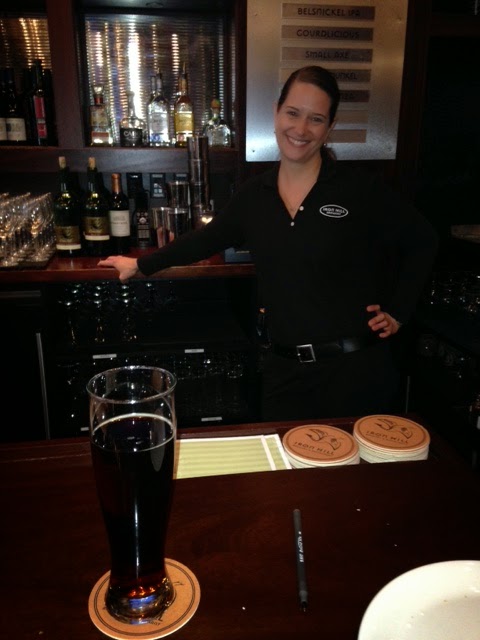 I settled on a Munich Dunkel, always a favorite back home the way Chuckanut brews it. The abv was 5.0% here and the IBUs were 18. Not hoppy-bitter, then, but it finished with a crisp tang I liked. Becky had worked a few years in the Seattle area, at Airways Brewing in Kent and the Dog and Pony in Renton, so it was fun to compare beer scenes.
The Iron Hill chain is going on twenty years now, having started in Delaware in 1996. It's here to stay.
(Visited 10/14/15)
For my next small glass, I went with one of the HB series, a Pig Iron Porter. My server, Becky, told me HB stood for House Beer, one of the five always on tap in each of the chain's pubs scattered across three states. Two more had SB following the title, seasonals which would also be on tap in every pub. The other seven were chosen by Chris, the head brewer, and would be found only here in Chestnut Hill.
The business model known as the chain brewpub or chain gastropub is characterized by small systems able to make enough beer for their own restaurants, little or no distribution to taverns, little or no bottling or canning,take-home sales limited to growler fills, and the same beers at each location, although brewers may have some latitude to add their own creations. In our region, McMenamins, the RAM chain, the Rock Bottom/Gordon Biersch combined entity, and the Elliott Bay brewpubs all exemplify this model. Diamond Knot is a combination of brewpubs and a production brewery. The desire of brewers to show what they can create pops up in most organizations of this type,
A brew kettle a bit under 14 barrels and a series of 12-bbl fermenters makes enough beer for this pub and the growler fills. There is one small exception to the model: the Bottled Reserves program. These are high-end brews, imperials, an English Barleywine, a Wee Heavy, and the like, in 750-ml bottles with champagne-style corking. They are priced from $16.50 to $20.50 and again, may vary some from one pub to another.
The Pig Iron Porter was a good finish to the gumbo. I wanted to try one more unique beer.
The Iron Hill chain is going on twenty years now, having started in Delaware in 1996. It's here to stay.
(Visited 10/14/15)

Wednesday, January 14, 2015
2nd Story Brewing: new craft spot in old Philly (new face II)
Several years ago, my Philadelphia-based daughter and I took in a brewpub called Triumph in the oldest part of her city, a few blocks from Independence Hall, the original Liberty Bell, and all that history. The pub had a stark modern look and the beers didn't celebrate the setting or stand out from decent craft beer anywhere. A couple of months ago, the story changed: this is the Second Story.
 The name derives from the location of the 15-barrel brewing system Triumph had installed on the second floor of the building. The main pub is on the street level. The property was purchased last year by Deb Grady, who was already busy farming some miles out of the city, in Pottstown, PA. Her Tilted Barn Farm inspires the name of one of the ales brewed here, Tilted Barn Saison, made in the farmhouse style at 5.2%. But there's more to this story: Grady planted hops on some of her acreage and picked the Cascade and Centennial buds used in this brew. Grady also intends to raise a small barley crop on a couple of acres of the farmland and have that malted for her head brewer (and son-in-law) John Wible. (Many of the facts reported here were published this month in GridPhilly.com, in a story written by Justin Klugh.)
A number of breweries grow a bit of hops on their premises or other land--not as much as Bale Breaker in Yakima, but a fair amount. Last month I revisited Brown's Brewing in Troy,NY, and l learned that they had opened a production brewery outside the city on sufficient land to root seven hundred rhizomes of hops. Klugh's article points out that back in 1850, New York State produced almost two-thirds of the hops grown in the U.S., and a good chunk more in Pennsylvania, no doubt.
 At any rate, a brewery using its own barley and hops will be a noteworthy example of locavore.
At the right, the pub scene is cozy and snug, beneath the fermenters. The menu is pub-plus--the restaurant scene in Philadelphia is extremely competitive, and wings and pizza won't pack 'em in even with the best beers on tap. The soup was black bean with lime, which paired well with the Grumpy Old Man Stout, 4% abv with some nice coffee notes from the malts and the espresso beans in the boil. Then I tried another 9-oz. glass of Root Cellar Helles, the Munich-style lager Chuckanut does so well back in Bellingham. They do it pretty well here, too, with the bitterness just sneaking in for the aftertaste.
(Visited 01/12/15)
A number of breweries grow a bit of hops on their premises or other land--not as much as Bale Breaker in Yakima, but a fair amount. Last month I revisited Brown's Brewing in Troy,NY, and l learned that they had opened a production brewery outside the city on sufficient land to root seven hundred rhizomes of hops. Klugh's article points out that back in 1850, New York State produced almost two-thirds of the hops grown in the U.S., and a good chunk more in Pennsylvania, no doubt.
At the right, the pub scene is cozy and snug, beneath the fermenters. The menu is pub-plus--the restaurant scene in Philadelphia is extremely competitive, and wings and pizza won't pack 'em in even with the best beers on tap. The soup was black bean with lime, which paired well with the Grumpy Old Man Stout, 4% abv with some nice coffee notes from the malts and the espresso beans in the boil. Then I tried another 9-oz. glass of Root Cellar Helles, the Munich-style lager Chuckanut does so well back in Bellingham. They do it pretty well here, too, with the bitterness just sneaking in for the aftertaste.
(Visited 01/12/15)
Subscribe to:
Posts (Atom)